Know Thyself, Pass the Exam: A Self-Assessment Guide for Banking Candidates Who Want a Study Strategy That Actually Fits
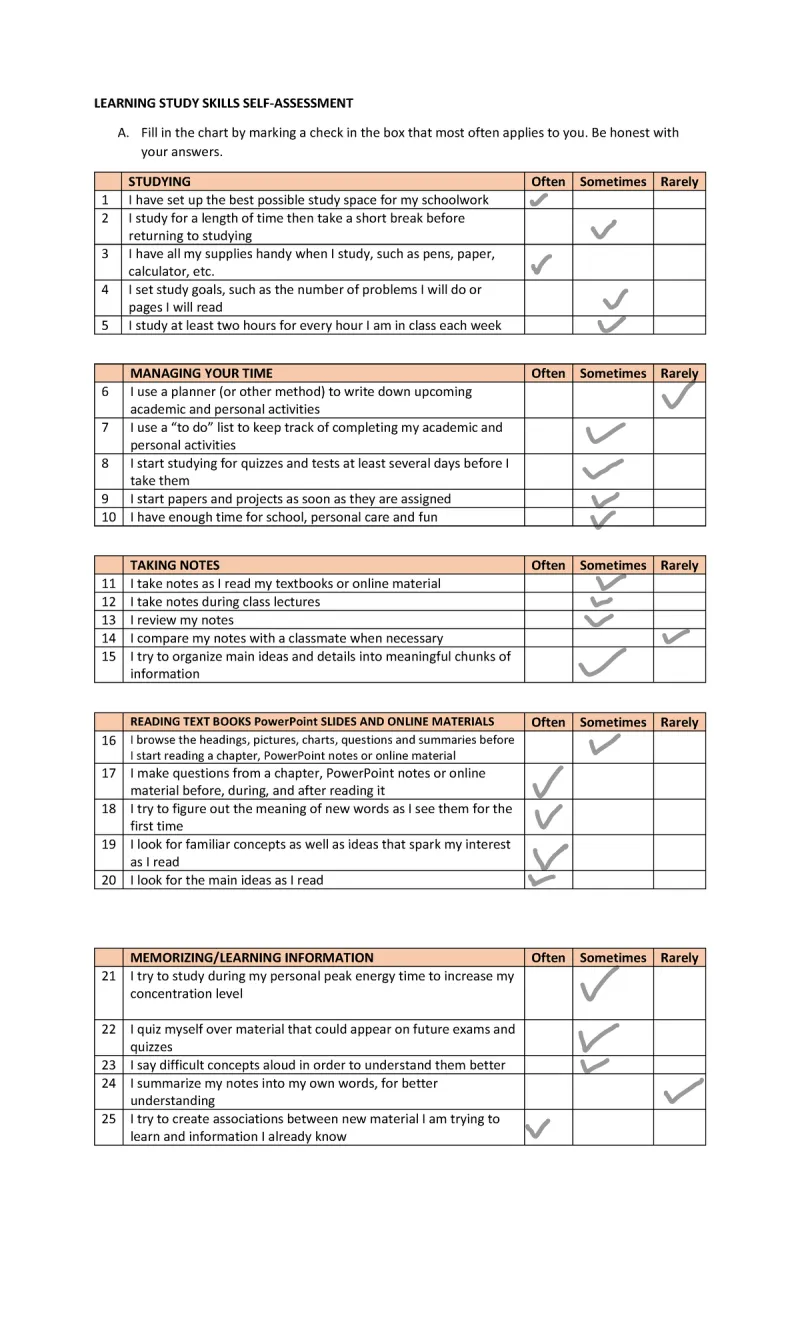
Photo: diverse professional taking notes with self-assessment checklist study strategy, via website-assets.studocu.com
Browse any banking exam forum and you will find the same recurring frustration: candidates who followed a well-regarded study plan, put in the hours, and still came up short. The plan was not necessarily wrong. The content was not necessarily lacking. What was missing, in many cases, was fit—the alignment between how a particular candidate learns best and how their preparation was actually structured.
Banking and financial services exams—whether you are pursuing a Series 63, a CFP certification, a CPA licensure, or an entry-level bank examiner credential—reward deep comprehension and rapid retrieval under time pressure. Both of those outcomes depend not just on what you study but on how your individual brain encodes, stores, and recalls information. Ignoring that variable is one of the most common and correctable mistakes among exam candidates.
Why One-Size-Fits-All Preparation Fails So Many Candidates
The standardized study guide exists for practical reasons. Publishers cannot write individualized curricula for every candidate, and most test-prep companies optimize for the median learner. That approach works reasonably well for candidates who happen to align with the median—but it leaves a significant portion of the test-taking population studying in a manner that is fundamentally inefficient for their cognitive profile.
Consider two candidates preparing for the same FINRA licensing exam. One retains information best through visual organization—flowcharts, color-coded outlines, and spatial diagrams that map regulatory relationships. The other learns primarily through auditory processing—listening to recorded lectures, talking through concepts aloud, and engaging in question-and-answer dialogue. If both candidates follow the same text-heavy, linear reading plan, one of them is working against their own neurology from day one.
Self-awareness does not replace content mastery. You still need to know the material. But self-awareness determines how efficiently you acquire and retain that mastery—and efficiency matters enormously when you are balancing exam preparation with a full professional and personal schedule.
Diagnostic Step One: Identify Your Dominant Learning Modality
The VARK model—Visual, Auditory, Reading/Writing, and Kinesthetic—remains one of the most accessible frameworks for identifying how you naturally process new information. While no one is purely a single type, most candidates have a dominant modality that, when engaged, accelerates learning significantly.
Ask yourself the following questions honestly:
- When you encounter a new concept, do you instinctively reach for a pen to draw a diagram or create a visual map? Visual tendency.
- Do you find yourself muttering explanations under your breath, preferring lectures to reading, or absorbing information better from podcasts than from textbooks? Auditory tendency.
- Do you gravitate toward written summaries, prefer taking detailed notes by hand, and find that writing out a concept helps you remember it? Reading/Writing tendency.
- Does passive study frustrate you? Do you learn better by doing—working through practice problems, simulating real scenarios, or physically moving while you review material? Kinesthetic tendency.
Once you have identified your dominant modality, the next step is restructuring your study resources accordingly. Visual learners should prioritize concept maps, color-coded notes, and visual summaries of regulatory hierarchies. Auditory learners benefit from narrated video courses, study groups where concepts are discussed aloud, and the practice of explaining material to an imaginary audience. Reading/Writing learners should lean into active note-taking, written self-testing, and essay-style summaries of key topics. Kinesthetic learners thrive with high-volume practice question work, simulation-based learning, and physical movement integrated into review sessions.
Diagnostic Step Two: Determine Your Preparation Rhythm
Beyond modality, the temporal structure of your study sessions has a profound impact on retention. Candidates generally fall into one of two broad rhythm profiles: the steady pacer and the intensive batcher.
Steady pacers perform best when they study in shorter, consistent sessions distributed evenly across weeks or months. For these candidates, spaced repetition—the practice of revisiting material at gradually increasing intervals—is highly effective and aligns naturally with their preference for regular, manageable engagement. A steady pacer who tries to cram material into marathon sessions in the final two weeks before an exam will often find that the information does not stick and that their confidence erodes under the accumulated pressure.
Intensive batchers, by contrast, find that immersive, concentrated study periods produce their best retention. They may struggle with short daily sessions that feel fragmented, but thrive when they can dedicate full days or extended weekends to deep engagement with a single subject area. For these candidates, a study calendar built around focused blocks—rather than daily increments—will feel more natural and produce better results.
Neither rhythm is superior. What matters is honest self-assessment. Think back to your most successful academic or professional learning experiences. Were they characterized by consistent daily engagement or by periods of intensive immersion? That pattern is almost certainly still your default, and your exam preparation schedule should honor it.
Diagnostic Step Three: Map Your Optimal Study Environment
Environment is a frequently overlooked variable in exam preparation. Research on context-dependent memory suggests that the conditions under which you encode information influence how readily you can retrieve it. While you cannot fully replicate a testing center in your living room, you can engineer your study environment to support the kind of focused, low-distraction processing that high-stakes exams demand.
Some candidates concentrate most effectively in complete silence; others require ambient background noise—a coffee shop hum or low-volume instrumental music—to maintain focus. Some need a dedicated, physically separate study space to signal to their brain that learning mode has begun; others can transition fluidly between environments without disruption. Some require rigidly structured sessions with defined start and end times; others do their best work in unstructured blocks that end when the material feels absorbed.
Spend one week deliberately varying your study conditions and noting which configuration produces the longest sustained focus, the lowest distraction rate, and the strongest performance on end-of-session self-quizzes. The data will tell you more than any general recommendation can.
Matching Your Profile to a Preparation Framework
Once you have a clear picture of your modality, rhythm, and environment preferences, the task is matching that profile to a structured preparation framework rather than abandoning structure altogether. Self-awareness is not a license to study however feels comfortable in the moment—it is a tool for making structured preparation more effective.
A visual, steady-pacer who studies best in quiet environments might build a twelve-week calendar of daily thirty-minute sessions centered on color-coded concept maps and spaced flashcard review. An auditory, intensive batcher who thrives in ambient environments might schedule four concentrated weekend study blocks, each anchored by lecture-based video content and followed by group discussion sessions.
The frameworks available through resources like BankExam Portal—including topic-sequenced study guides, timed mock exams, and subject-specific practice question banks—are designed to be modular precisely so that candidates can adapt them to their individual profiles rather than following a single linear path.
The Competitive Advantage Nobody Talks About
In a field where most candidates are working from the same approved study materials and the same regulatory content outlines, self-knowledge is a genuine differentiator. The candidate who understands how their brain works—and builds a preparation strategy around that understanding—is not just studying smarter in the abstract. They are extracting more usable knowledge per hour invested, retaining it longer, and accessing it more reliably under test conditions.
That advantage does not require a psychology degree or an expensive assessment tool. It requires thirty minutes of honest reflection, a willingness to experiment, and the discipline to act on what you discover about yourself.
Your exam preparation begins with the material. But it is perfected through self-knowledge.